
What We Found in 1,814 Acne Blood Tests (Q4 2026)

By BreakoutLabs · Q4 2026 edition · Updated quarterly; next edition Q1 2027
Why we ran this
Acne is almost always treated as a skin problem. Most people are handed a cleanser, a cream or an antibiotic, and very few ever have their hormones, blood sugar or nutrients checked. We wanted to answer a simple question: when people with acne actually look inside, how often is something off?
We also wanted to see whether the answer changes with age. Adults with acne often get told they should have outgrown it by now, so we compared women 30 and over with women under 30.
The short answer: about 1 in 3 people in our sample had at least one of six key markers out of range, and the picture was similar for women under and over 30: 36% of women 30 and over, 32% of women under 30. And about 1 in 4 had vitamin D under 30 ng/mL, a level guidelines consider insufficient.
Summary: We looked at the combined, anonymous results of a sample of 1,814 adults who took a BreakoutLabs at-home acne blood test, with results returned between November 2025 and September 2026. Here is how often hormones, blood sugar and vitamin D came back outside the lab reference range, by sex and age.
- Of the 1,806 people in our sample with hormone results, 23% had at least one hormone marker outside the lab reference range.
- Women 30 and over looked much like younger women: 36% had at least one of six markers out of range, compared with 32% of women under 30.
- 11% of women had total testosterone above the reference range, and the share stayed in a similar range at every age.
- 13% of people who took an acne blood test had vitamin D below the lab reference range, and 24% were under 30 ng/mL, the level guidelines consider insufficient.
- 12% of men who took an acne blood test had SHBG below the reference range, the protein that keeps testosterone in check.
1,814
adults in this sample (a subset of all tests we've run)
34%
had at least one of six key markers out of range
24%
had vitamin D under 30 ng/mL
★★★★★ Rated 4.8 by 6,000+ customers
Find out what your blood says about your breakouts
- At-home test with a painless arm device
- 19 biomarkers across hormones, blood sugar, metabolism and nutrients
- Results in about 5 business days, with a personal Clear Skin Blueprint
Key findings
- 34% of people in our sample (608 of 1,806) had at least one of six key markers outside the lab reference range. Among the 1,237 people with all six reported, 64% had every marker in range.
- Of the 1,806 people in our sample with hormone results, 23% had at least one hormone marker outside the lab reference range.
- Women 30 and over looked much like younger women: 36% had at least one of six markers out of range, compared with 32% of women under 30.
- 11% of women had total testosterone above the reference range, and the share stayed in a similar range at every age.
- 13% of people who took an acne blood test had vitamin D below the lab reference range, and 24% were under 30 ng/mL, the level guidelines consider insufficient.
- 12% of men who took an acne blood test had SHBG below the reference range, the protein that keeps testosterone in check.
- 14% of women had free testosterone above the lab reference range. The lab's upper limit for women tightens with age, so we report this across all women rather than comparing age groups.
- 8% of men had total testosterone below the reference range.
Hormones: how often they came back out of range
We counted a person as having a hormone marker out of range if free testosterone, total testosterone, SHBG or DHEA-S came back above or below the lab reference range on their first test. Across everyone, that was 23%. For women it was 24%, and for men 21%.
Total testosterone
11% of women had total testosterone above the reference range, and this was similar at every age: 14% at 18 to 24, 9% at 25 to 34, 12% at 35 to 44 and 14% at 45 and over. Acne with high testosterone is not just a young-skin problem or an older-women problem.
Free testosterone
14% of women had free testosterone above the reference range. Free testosterone is the unbound, active share, and higher levels are linked to more oil and breakouts. The lab's upper limit for women gets tighter with age, so a younger and an older woman with the same number can get different flags. That's why we report this across all women instead of comparing age groups.
SHBG
SHBG is the protein that binds testosterone and keeps it in check. 3% of women and 12% of men had SHBG below the reference range. Read more about low SHBG and acne.
Vitamin D and blood sugar
13% of people had vitamin D below the lab reference range. Among women, it was 16% at 25 to 34. But that lab range was generous. Using the cutoffs in Endocrine Society guidelines, 24% of people had vitamin D under 30 ng/mL, which is considered insufficient, including 4.5% under 20 ng/mL, which is considered deficient. For women under 30 it was 27%, and for women 30 and over it was 23%. Low vitamin D is associated with acne in several studies, though it is not shown to cause it.
On blood sugar, this test's HbA1c range ran up to 6.4%, so a flag only caught readings of 6.5% and over. 0.9% of women were flagged, but that doesn't mean blood sugar was fine for everyone else. Our current test uses a tighter range, and we plan to report blood sugar against a named cutoff in a future edition.
All results by sex and age band
Each figure is the share of people in that group whose first result was above or below the reference range the lab printed. "n" is the number of people in the group with that marker.
At a glance: women, by marker
| Marker | 18 to 24 | 25 to 34 | 35 to 44 | 45 and over | All women |
|---|---|---|---|---|---|
| Total testosterone above range |
13.6% n=332 |
9.1% n=474 |
11.6% n=335 |
13.6% n=103 |
11.3% n=1,244 |
| Vitamin D below range |
11.6% n=397 |
16.3% n=575 |
10.9% n=411 |
9.8% n=122 |
13.1% n=1,505 |
Across all women: free testosterone above range 14.1%, SHBG above range 4.6%, SHBG below range 3.3%, DHEA-S above range 3.0%, free testosterone below range 1.9%, DHEA-S below range 0.9%, HbA1c above range 0.9% and vitamin D above range 0.7%.
| Marker | 18 to 24 | All men |
|---|---|---|
| Total testosterone below range |
9.0% n=133 |
8.2% n=220 |
| SHBG below range |
12.2% n=156 |
12.0% n=251 |
| Vitamin D below range |
9.3% n=151 |
10.2% n=245 |
Across all men, free testosterone was below range in 3.3% and DHEA-S below range in 3.6%.
| Group | People | At least one of six markers out of range | All six in range* |
|---|---|---|---|
| Everyone | 1,806 | 33.7% | 63.9% |
| Women | 1,546 | 34.5% | 62.1% |
| Women under 30 | 690 | 32.5% | 66.1% |
| Women 30 and over | 856 | 36.1% | 58.9% |
| Men | 260 | 28.8% | 73.3% |
*Of people with all six markers reported.
What this means
Conclusion: for about 1 in 3 people in our sample, something inside came back out of range, for women under and over 30 alike. Women 30 and over looked much like women under 30, and high total testosterone showed up at a similar rate from 18 to 45 and beyond. About 1 in 4 people had vitamin D under 30 ng/mL, the level guidelines consider insufficient. For the other two thirds, these six markers were in range, which rules out a lot of guessing.
That matters because none of these show up in a mirror, and most can't be fixed with skincare. If your acne has hung around into adulthood, keeps coming back along your jaw, or hasn't responded to the usual treatments, the most useful next step is to find out whether one of these internal drivers is part of the picture, instead of trying another product.
Related reading: acne in your 30s or 40s, perimenopause acne and normal bloodwork but still have acne.
Frequently asked questions
How common are hormone problems in people with acne?
In our sample of 1,806 adults with hormone results, 23% had at least one hormone marker (free testosterone, total testosterone, SHBG or DHEA-S) outside the lab reference range.
Is low vitamin D common in people with acne?
Yes. 13% of people in our sample were below the lab reference range, and 24% were under 30 ng/mL, the level Endocrine Society guidelines consider insufficient.
Is acne in your 30s different from acne in your 20s?
Inside, it looked similar in our data. 36% of women 30 and over had at least one of six key markers out of range, compared with 32% of women under 30.
How can I find out if my acne is hormonal?
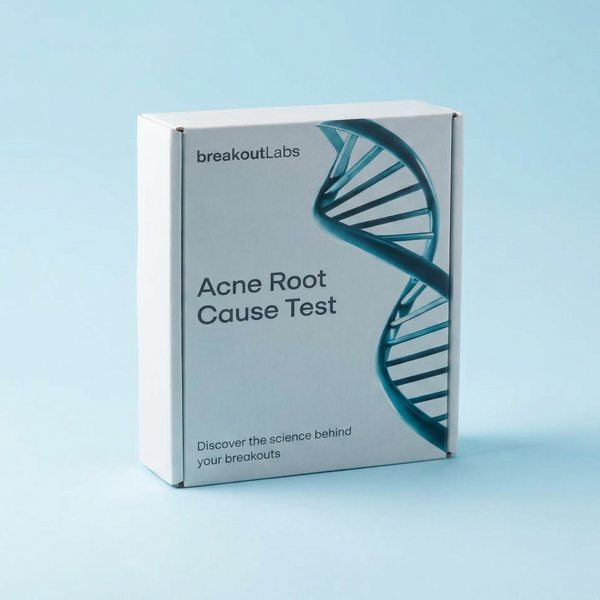
A blood test is the way to know. The Acne Root Cause Test checks 19 biomarkers across hormones, blood sugar, metabolism and nutrients, collected at home with a painless arm device.
Method
- Sample: 1,814 adults (1,554 women, 260 men) who took a BreakoutLabs at-home acne blood test, a subset of all tests we have run. First test per person, collected with our earlier dried blood spot method, results returned November 2025 to September 2026, processed by a CLIA-certified lab.
- Markers: free testosterone, total testosterone, SHBG, DHEA-S, vitamin D (25-OH) and HbA1c.
- Out of range: outside the reference range printed by the lab, which can differ by sex and age. Free testosterone is not compared across age groups for that reason. Vitamin D under 30 ng/mL is insufficient and under 20 ng/mL is deficient, per Endocrine Society guidelines.
- Excluded: anyone recorded as under 18, incomplete records, samples flagged for quality, and retests.
- Privacy: combined, anonymous counts only. No group under 50 people is reported.
- Limits: people who chose to test, not a population sample. Associations, not causes.
How to cite this
BreakoutLabs (2026). What We Found in 1,814 Acne Blood Tests (Q4 2026). https://trybreakoutlabs.com/blogs/learn/acne-blood-test-findings. Accessed [date].
You are welcome to quote these figures with a link to this page. Updated quarterly; next edition Q1 2027.
See where your own markers land
One at-home test. 19 biomarkers. Answers in about 5 business days. And if every marker comes back in normal range, our 30-day money-back guarantee has you covered.
See today's offerHSA/FSA eligible · Rated 4.8 by 6,000+ customers


