
Acne During Ovulation: What Causes Mid-Cycle Breakouts

Short answer: yes, ovulation can cause acne. In the few days around ovulation, your body releases a surge of luteinizing hormone (LH), estrogen peaks, and testosterone and free testosterone rise to their highest point of the month. Right after, progesterone starts to climb. For skin that is sensitive to androgens, that mid-cycle testosterone bump can mean more oil and a few new breakouts, usually on the chin and jawline. Whether your mid-cycle acne comes from androgens, blood sugar or something on your skin is different for everyone, so the way to know is to test.
★★★★★ Rated 4.8 by 6,000+ customers
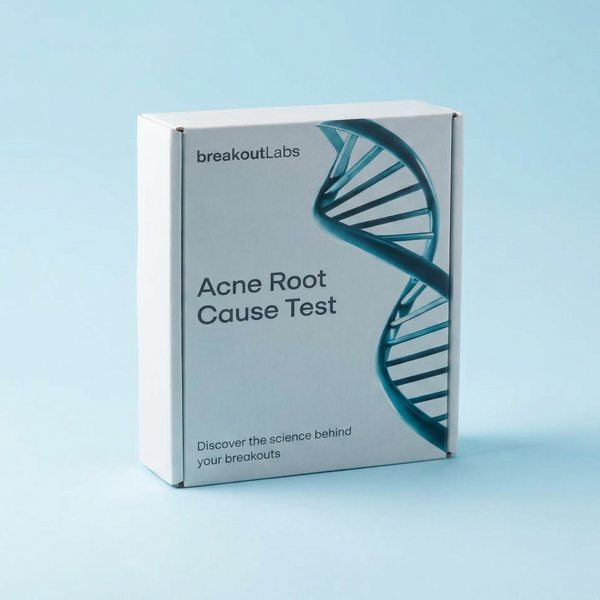
Find out what's really behind your ovulation breakouts
- At-home test with a painless arm device
- 19 biomarkers across hormones, blood sugar, metabolism and nutrients
- Results in about 5 business days, with a personal Clear Skin Blueprint
Does ovulation cause acne?
Ovulation itself doesn't make a pimple. The hormones that trigger it can. Ovulation is the moment an ovary releases an egg, usually around the middle of your cycle. To get there, your brain and ovaries run a tightly timed hormone sequence, and several of the hormones involved also talk to your oil glands.
The one that matters most for acne is testosterone. Most people think of it as a male hormone, but ovaries make it too, and it is the main signal that tells oil glands to make more oil (Elsaie, 2016). In a study that measured hormones with a precise lab method across the cycle, total testosterone, free testosterone, estrogen and SHBG all peaked at mid-cycle (Rothman et al., 2011). A 2026 study of naturally cycling women found the same thing: total and free testosterone were significantly higher in the ovulatory phase than during the period (Salmi et al., 2026).
So if you notice a few deeper, oilier breakouts roughly two weeks before your period, your skin may be reacting to that mid-cycle androgen bump. Most research on cycle acne has focused on the week before the period, so ovulation acne is less studied. But the hormone pattern behind it is well documented, and many women recognize it in their own skin.
Your cycle, phase by phase, and what your skin may do
A typical cycle runs about 28 days, with most falling between 25 and 30 days (Reed and Carr, 2018). Day 1 is the first day of bleeding. Here's how the main hormones move, and how acne tends to follow:
| Phase | Rough days (28-day cycle) | What your hormones are doing | What your skin may do |
|---|---|---|---|
| Period (early follicular) | Days 1 to 5 | Estrogen and progesterone are low. Testosterone sits near its monthly baseline. | Breakouts from the week before may linger or heal. Some people flare during bleeding. |
| Late follicular | Days 6 to 12 | Estrogen rises steadily as a follicle grows. | Often the calmest, clearest stretch of the month. |
| Ovulation | Around days 13 to 15 | The LH surge triggers ovulation. Estrogen peaks. Testosterone and free testosterone reach their monthly high (Rothman et al., 2011; Salmi et al., 2026). | More oil and shine. A few new spots, often on the chin, jawline or around the mouth. |
| Luteal | Days 16 to 28 | Progesterone climbs and peaks about a week after ovulation, then both progesterone and estrogen fall before your period. | The classic premenstrual flare, which is the most common cycle pattern (Stoll et al., 2001). |
Your days may be shifted if your cycle is shorter or longer. Ovulation happens about 14 days before your next period, not always on day 14.
Why acne during ovulation happens
Four things change around ovulation, and each one can nudge your skin in a different direction.
1. The LH surge and the testosterone bump
LH is the pituitary hormone that triggers ovulation. Besides releasing the egg, LH also stimulates the ovary's theca cells, which are the cells that make androgens (Reed and Carr, 2018). That's part of why testosterone rises mid-cycle. More free testosterone reaching the oil gland means more sebum, and more sebum plus dead skin cells that don't shed properly is how a clogged pore starts (Elsaie, 2016).
How we check this: The Acne Root Cause Test measures total and free testosterone, DHEA-S and the Free Androgen Index, so you can see how much androgen your skin is working with. We collect on days 3 to 7 of your cycle to get a clean baseline, not your mid-cycle peak. See what's tested
2. Estrogen peaks, then drops
Estrogen is generally on your skin's side. It pushes the liver to make more SHBG, the protein that holds testosterone and keeps it inactive, and it counters testosterone's action in the oil gland (Elsaie, 2016). Estrogen hits its highest point right before ovulation, then dips sharply after the egg is released. For a few days, androgens can have more of an edge, especially if your SHBG is already on the low side.
How we check this: The test measures SHBG and albumin alongside your testosterone, so you can see how much of it is free to reach your oil glands when estrogen dips. See what's tested
3. Progesterone rises after ovulation
Once the egg is released, the empty follicle becomes the corpus luteum, which makes progesterone (Reed and Carr, 2018). Progesterone climbs through the second half of your cycle. Researchers link premenstrual acne flares and sebum changes to this progesterone phase (Elsaie, 2016; Raghunath et al., 2015). If your breakouts start at ovulation and get worse over the following week, you may be feeling both the mid-cycle androgen bump and the luteal shift.
4. Your baseline decides how much it shows
Everyone gets the mid-cycle rise. Not everyone breaks out from it. The difference is often your starting point:
- Low SHBG. When SHBG is low, more of your testosterone is free to act on your skin, so the same monthly bump hits harder. More on this in low SHBG and acne.
- Blood sugar. Insulin lowers SHBG production by the liver and pushes the ovaries to make more androgens (Elsaie, 2016). Higher blood sugar can raise your free testosterone without your total testosterone changing.
- Higher androgens overall. If your free testosterone or DHEA-S already runs high, the ovulation peak can push you over your skin's threshold. Conditions like PCOS often show up this way. See PCOS and hormonal acne.
How we check this: The test measures HbA1c and average glucose plus a full cholesterol and triglyceride panel, so you can see if blood sugar is lowering your SHBG and making the monthly bump hit harder. See what's tested
Ovulation acne vs period acne: how to tell them apart
Timing is the biggest clue. Here's how the common cycle patterns compare:
| Pattern | When it shows up | Main hormone story |
|---|---|---|
| Ovulation acne | Mid-cycle, about 2 weeks before your period | LH surge, testosterone and free testosterone peak, estrogen drops after ovulation |
| Premenstrual acne | The 7 to 10 days before your period | Progesterone high, then estrogen and progesterone fall |
| Period acne | During bleeding | Estrogen and progesterone at their lowest, plus leftover luteal breakouts |
| All-month acne with cycle flares | Constant, with spikes | Often a higher baseline: androgens, SHBG, blood sugar or a mix |
The week before your period is still the most common flare. In a survey of 400 women, 44% had premenstrual acne flares (Stoll et al., 2001). Among adult women with cycle-related acne in another survey, 56% got worse the week before their period, 17% during it, and 24% said symptoms were worse throughout their cycle (Geller et al., 2014). If your skin acts up before or during your period, read our full guide to period and menstrual acne.
Some people get two flares a month: a smaller one at ovulation and a bigger one before the period. That double pattern points toward an androgen-sensitive baseline, which is exactly what bloodwork can show.
What ovulation acne looks like
- Location: usually the lower face, so the chin, jawline and around the mouth. This lower-face pattern is typical of adult female acne in general (Dréno et al., 2013). See chin and jawline acne causes.
- Type: tender, under-the-skin bumps or a few inflamed spots rather than lots of tiny whiteheads.
- Feel: skin that seems oilier or shinier than usual for a few days.
- Timing: shows up around the middle of your cycle and often calms as you move into the follicular phase after your period.
Is this you?
- ☐ You break out about two weeks before your period, at the same point every month
- ☐ New spots land on your chin, jawline or around your mouth
- ☐ Your skin turns oilier or shinier for a few days mid-cycle
- ☐ You get two flares a month, one at ovulation and another before your period
- ☐ You've cleaned up your routine and the monthly pattern still hasn't budged
If two or more sound like you, the cause is likely internal, and no product on your shelf can show you that. A blood test can.
Find my root cause★★★★★
"My breakouts followed a pattern every month, but I never knew why. The results helped explain what was driving that cycle."
Allison G. · Verified BreakoutLabs customer
Is it ovulation, or something else?
Mid-cycle timing is a strong hint, but a few other things can line up with the same week. Rule these out as you track:
- A new product. A new moisturizer, sunscreen or foundation can clog pores within a couple of weeks and land right around ovulation by chance. Run your routine through our free Pore Clogger Checker.
- Stress and sleep. A hard week often brings breakouts on its own, whatever your cycle is doing.
- Friction. Phone screens, masks, helmet straps and resting your chin in your hand all show up along the jawline.
- A cycle that isn't regular. If you don't know when you ovulate, or your cycles are often longer than 35 days, "ovulation acne" may really be all-month hormonal acne. Irregular cycles plus acne are worth raising with your provider, because together they can point toward PCOS.
Why we test early in your cycle, not at ovulation
If your acne shows up at ovulation, it's natural to think you should test at ovulation. For a blood test, the opposite works better.
Testosterone and free testosterone naturally rise mid-cycle (Rothman et al., 2011; Salmi et al., 2026). A sample taken at ovulation catches you at your monthly peak, which can make your numbers look higher than your real baseline, or make a result hard to compare with standard ranges. That's why hormonal acne workups are done in the early part of the cycle, the follicular phase (Elsaie, 2016).
So BreakoutLabs asks you to collect on days 3 to 7 of your cycle if you menstruate. That gives a clean, comparable baseline. The question we're answering is: "what is your skin working with every day of the month?" If your baseline free testosterone is high, your SHBG is low or your blood sugar is running high, the ovulation bump lands on top of that, and that's what shows up on your chin.
The rest of the timing rules work the same way. Collect Monday to Thursday, within 1 to 2 hours of waking, after an 8 to 10 hour fast (water is fine). Hormones and blood sugar both shift through the day and after meals, so morning fasting samples are the most consistent.
What you can do about ovulation acne
- Track two or three cycles. Note the first day of your period and the days new spots appear. If breakouts keep landing about two weeks before your period, you've found your pattern.
- Get ahead of the window. If you know your flare days, that's the week to stay consistent with the routine that already works for you, rather than trying something new.
- Clean up your product list. Check every leave-on product with the Pore Clogger Checker so you aren't adding clogged pores on top of a hormone bump.
- Steady your blood sugar. Because insulin lowers SHBG and raises androgen production (Elsaie, 2016), meals built around protein, fiber and whole foods help keep the androgen side calmer. See how blood sugar affects your skin.
- Know your numbers. A cycle pattern tells you hormones are involved. Bloodwork tells you which ones. That's what turns guessing into a plan you and your provider can act on.
If you're weighing hormonal treatments against other approaches, our guide to managing hormonal acne with birth control vs natural approaches walks through the options.
Your options for finding the cause, compared
| Guessing (cycle tracking, new products) | Dermatologist visit | In-clinic lab draw | BreakoutLabs | |
|---|---|---|---|---|
| Looks inside your body | No | Rarely | Only what's ordered | Yes, 19 biomarkers |
| Built for acne | No | Treats the surface | General panels | Yes |
| Time to an answer | Months, often never | Weeks for an appointment | Referral, visit, then wait | About 5 business days |
| From home | Yes | No | No, needle draw | Yes, painless arm device |
| Plan you can act on | No | Usually a prescription | Numbers only | Personal Clear Skin Blueprint |
In our own data from 1,814 acne blood tests, about 1 in 3 people had a key marker out of range. See what we found.
Why test with BreakoutLabs
Ovulation acne is a timing clue. The Acne Root Cause Test is the clearest next step, because it shows you the baseline underneath that clue: which of your androgens, SHBG or blood sugar is turning a normal monthly bump into breakouts. Here's what you get:
- At home, with a painless device on your upper arm. No lab visit, no appointment, no needle draw.
- 19 biomarkers across hormones, blood sugar, metabolism and nutrients: Free and Total Testosterone, SHBG, DHEA-S, Free Androgen Index and Albumin; HbA1c, average glucose and a full cholesterol and triglyceride panel; ALT, Creatinine and eGFR; and Vitamin D.
- Timed for a clean read. Collect on days 3 to 7 of your cycle, so your results reflect your true baseline, not your mid-cycle peak.
- Physician-authorized and processed by a CLIA-certified lab, with results in 5 business days after the lab receives your sample.
- A personalized Clear Skin Blueprint that reads your results through the lens of acne, including how your SHBG and blood sugar shape your free testosterone.
- HSA/FSA eligible, and backed by our 30-day money-back guarantee.
For ages 14 and up (14 to 17 with a parent or guardian).
Stop guessing about your mid-cycle breakouts
One at-home test. 19 biomarkers. Answers in about 5 business days. And if every marker comes back in normal range, our 30-day money-back guarantee has you covered.
See today's offerHSA/FSA eligible · Rated 4.8 by 6,000+ customers
Frequently asked questions
Does ovulation cause acne?
It can. Around ovulation, testosterone and free testosterone reach their monthly high and estrogen drops right after the egg is released. In androgen-sensitive skin, that shift can raise oil production and trigger a few breakouts, usually on the lower face.
Is acne during ovulation normal?
Mild mid-cycle breakouts are common, because everyone gets the same hormone surge. If you break out every month at ovulation and again before your period, or your acne is deep and painful, it's worth checking your free testosterone, SHBG and blood sugar.
How long does ovulation acne last?
The hormone peak lasts a few days, but a pimple that forms then can take a week or more to heal. Many people find mid-cycle spots fade during the follicular phase after their period.
Why do I break out after ovulation?
After ovulation, estrogen dips and progesterone climbs through the luteal phase. Researchers link premenstrual flares to this phase, so breakouts that start at ovulation can carry on until your period.
Can ovulation acne be a sign of pregnancy?
No. Acne can't tell you whether you're pregnant. Mid-cycle breakouts happen in cycles with and without conception, so use a pregnancy test if you need an answer.
Should I test my hormones during ovulation?
Not for an acne baseline. Testosterone naturally peaks mid-cycle, so a sample taken then can look higher than your usual level. BreakoutLabs asks you to collect on days 3 to 7 of your cycle for a clean, comparable read.
Sources
- Elsaie ML. Hormonal treatment of acne vulgaris: an update. Clinical, Cosmetic and Investigational Dermatology. 2016.
- Rothman MS, Carlson NE, Xu M, et al. Reexamination of testosterone, dihydrotestosterone, estradiol and estrone levels across the menstrual cycle and in postmenopausal women measured by liquid chromatography-tandem mass spectrometry. Steroids. 2011.
- Salmi VM, Mikkonen RS, Löfberg IE, et al. Changes in androgen profile over the menstrual cycle and hormonal contraceptive phases in physically active females. BMC Women's Health. 2026.
- Reed BG, Carr BR. The normal menstrual cycle and the control of ovulation. Endotext. 2018.
- Stoll S, Shalita AR, Webster GF, et al. The effect of the menstrual cycle on acne. Journal of the American Academy of Dermatology. 2001.
- Geller L, Rosen J, Frankel A, Goldenberg G. Perimenstrual flare of adult acne. Journal of Clinical and Aesthetic Dermatology. 2014.
- Raghunath RS, Venables ZC, Millington GW. The menstrual cycle and the skin. Clinical and Experimental Dermatology. 2015.
- Dréno B, Layton A, Zouboulis CC, et al. Adult female acne: a new paradigm. Journal of the European Academy of Dermatology and Venereology. 2013.
This article is for educational purposes and is not medical advice. Talk to your healthcare provider about testing and treatment.


